The origins of Europe's dedicated rail freight corridors
Where new European rail axes totally dedicated to freight began
After we created the F&L Forum in 1994, a series of events very quickly sealed its recognition and reputation at EU level.
First, F&L’s standing as totally independent: a non-political, non-lobby organisation, whose objectives were solely about supporting senior freight logistics peer & expert exchange across the international multi-stakeholder ecosystem. All other organisations were in effect lobbying for concessions or favours for the categories they were representing. F&L upholds its independence and neutrality still today in 2026.
In the late 90s, the influence of DG Transport on EU affairs did not exist: transport, together with the EU Transport Commissioner, was considered next to nothing. Neil Kinnock was the first EU Transport Commissioner and EU Vice President who put DG Transport on the EU map. F&L was engaged to organise two specific EU meetings in Brussels for DG Transport because they did not have either the contacts or the credibility at that time to do it alone. For the above reasons meetings between an F&L delegation and the EU Commissioner for Transport and EU Vice President became regular to tackle agendas related to mobility challenges.
Freight Freeways
Following these regular meetings, the idea of “Freight Freeways” was put on the table to signify the EU need for easier access to rail infrastructure for attracting additional freight volumes to rail. Myself as F&L President and Armand Toubol (F&L) were part of the ” five wise men” Board. There was also a representative of SeaLand, one representative of the Union of Railwaymen (now RMT) and one representative of a UK Transport Association. We were called to put on the ground this framework idea, and several enlarged meetings at EU level originated. The “Freight Freeways” idea caught the imagination of the EU people and was hotly debated for many months. I remember we were invited by Neil Kinnock to his private apartment in Brussels for dinner as a recognition of our work.
New European rail axes totally dedicated to freight
From these “Freight Freeways” meetings, the Newopera idea of new European rail axes totally dedicated to freight started to materialise into our minds and the Newopera project concept was launched in Lisbon, on occasion of the F&L meeting in year 2000, as an F&L project. A steering group was formed composed by myself, Toubol (SNCF), Emilio Fernández (Transfesa), Rune Svensson (Volvo), Johannes Fritzen (VW) and Horst Kubek (LKW Walter) to conceive a “road map to execution”. We were called dreamers, but one needs new dreams for imagining new scenarios and what is not apparently visible.
We, the F&L project Newopera steering group, had various dedicated meetings around Europe. Calculations were made for investments, benefits, new traffic volumes, IRR (Interest Rate of Return) including environmental benefits for reduced congestion, CO2 emissions reduction in millions of tons, energy savings, fossil fuel savings etc. We had many enemies, we were accused of being lunatics, not realistic. The concept did not stand any chance of being accepted. Even the EU Commission were sceptical. We were serious and determined. Did not give up.
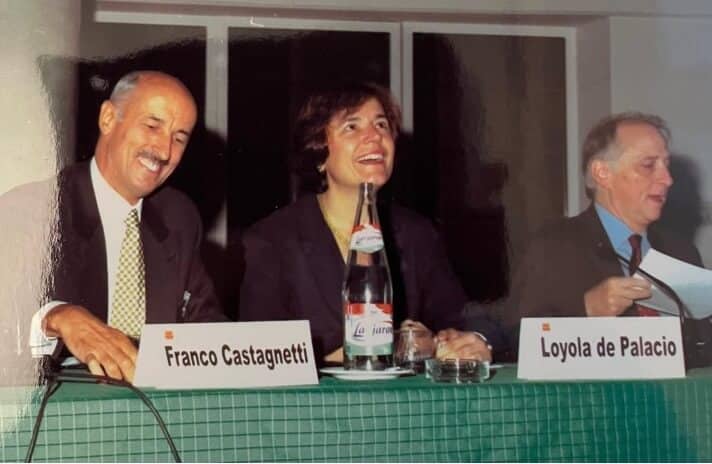 Meantime the Romano Prodi (F&L interview with Mr Prodi) EU Presidency took charge, with Loyola de Palacio as EU Transport Commissioner and EU Vice President. We continued our presentations within F&L and as F&L President I was invited to make presentations at all EU rail-interested Associations including different freight and road associations such as IRU.
Eventually F&L provoked such a big noise around Europe on this project – it was gaining momentum becoming the biggest new original mobility innovation ever conceived – that F&L was called to make a dedicated presentation at the EU DG Transport (now DG MOVE). Jean-Arnold Vinois, Director for the rail sector, declared Newopera as “the greatest innovative project on transport mobility capable of mobilising EU transport policy resources for the next 50 years”.
Alleluja: Newopera was given dignity and an official seal of approval.
Intermodality, vehicle standardisation, weights, and transport security
The F&L reputation for the above EU interactions grew further during these years. F&L was engaged by EU to put together a EU delegation formed by leading transport experts and logisticians representing the top EU industries to meet a similar USA delegation organised by DOT US Government (Department of Transport) to discuss major topics of intermodality, vehicle standardisation, weights, and transport security. Five meetings took place in successive years in Washington, Munich, New York, Genoa, Jacksonville with key F&L actors involved which started a dialogue across the Atlantic with IANA (Intermodal Association of North America) participation. These delegations formed by F&L members, were headed by the DG Transport chief at that time, having on the opposite side the Head of DOT. In Genoa we had the Italian Transport Minister and Loyola de Palacio. The EU delegation managed to agree the standardisation of the containers size to max 45′. The USA at that time were already considering 48′ and 52′.
F&L meantime put at work several project groups with the task of producing published “booklets” analysing in details transport topics of common European interest.
ERRAC European Rail Research Advisory Council was formed under the auspices of the EU Commission and F&L was called to be part of it as key actor. The other members were mainly institutional employees from Transport Ministries of the various member countries. We were entrusted to produce the SRRA (Strategic Rail Research Agenda). Dedicated meetings took place, and the first written SRRA emerged as a “White Paper” in which the key strategic point was the establishment of a “high-speed rail network of 15,000 Km” connecting all EU member countries. This was a major F&L victory since the establishment of 15,000 km of high-speed lines for passengers was, in fact, the greatest freight project ever conceived: generating redundant space on the existing rail network available for freight. Dreams started to become reality.
The EU Commission inserted the Newopera project concept into a “Call for Proposal” and F&L was invited to participate. Having retired at the end of 2001 as EniChem Director I committed myself, with F&L, to take the Newopera project management and responsibility. The F&L Newopera project consortium won the Call obtaining a 5MM finance contribution for developing and elaborating this project concept idea. The Newopera project was brought to conclusion in Sept. 2008, with the publication of a book with global ISBN Intellectual Property Protection summarising all technical, scientific and market findings (all publications, book).
All modalities must perform at their best
The F&L Newopera dedicated rail freight lines concept became the key strategic issue in these years. The snowball effect was such that every freight association in Brussels wanted to be part of it. Major allies were CER (Central European Railways), EIM (European Rail Infrastructure Managers), and UNIFE (European Rail Supply Industry). CER, in order to give this concept its own individual imprint, launched the PERFRN (Preferential European Rail Freight Network) to which F&L was called to participate. The EU rail system did not like very much that this new rail concept network was invented by F&L NON-rail people, but F&L members were in fact representing the rail customers community. This artificial antagonism between rail service providers and customers was confirmation of the rail companies being totally NON customer-oriented at that time.
F&L in those years was a key actor in the promotion of the EU Legislation called ” The European Rail Network for Competitive Freight” which formally recognised ” Freight traffic on rail lines” as having the same dignity as “Passenger Traffic”. Nowadays the SRRA dream of 15,000km of high speed lines linking all EU countries is an established reality together with the elimination of rail bottlenecks indicated in the Newopera project which plagued rail freight traffic fluidity. (The PERFRN initiative was absorbed by mandatory EU legislation and permanent, legally binding structures, but it paved the way for the institutional frameworks that manage European rail logistics today).
Newopera is without any shadow of a doubt the originator of the EU TEN-T network, which originated from the Newopera research of technical, scientific and economic findings.
After I left the F&L Presidency, following my exit from EniChem, Emilio Fernández took over, giving the Newopera Project in execution his unconditional support. Without his support it would have been difficult to bring the Newopera project to a positive conclusion. In fact, in F&L there was by then a prevalence of road oriented transport and logistics members and Newopera project did not enjoy much support. These were the years of the “Jumbo trucks” which were never adopted. This antagonism between Road and Rail was in fact a very short-sighted vision. It was apparent also in those years that the EU Mobility system, in order to be efficient and able to compete with the economies of other continents, needed all modalities to perform at their best, and rail was certainly the one needing most attention. Not all actors in Europe for defending their backyard interests, had the intelligence to understand this basic paradigm.
Following the Newopera project conclusion, a few of us founded Newopera Aisbl in November 2007 in Brussels for continuing other freight project development innovations. Newopera Aisbl after accomplishing many other successes on EU mobility Projects both freight and passengers, was closed and liquidated on 31.12.2024, with the final retirement from any activity of its founding members. Eurnex administers the “Newopera Prize for Rail Freight and Intermodality” for MSc and PhD students of the Rail Freight sector and C.I.S.Co. (Centro Internazionale Studi Containers) through Genoa University supports “Tuitions in the combined transport field” which is open to new generations for the years to come.
F&L remains as an enabler and facilitator for those who are serious about change.
June 2026
Related Posts
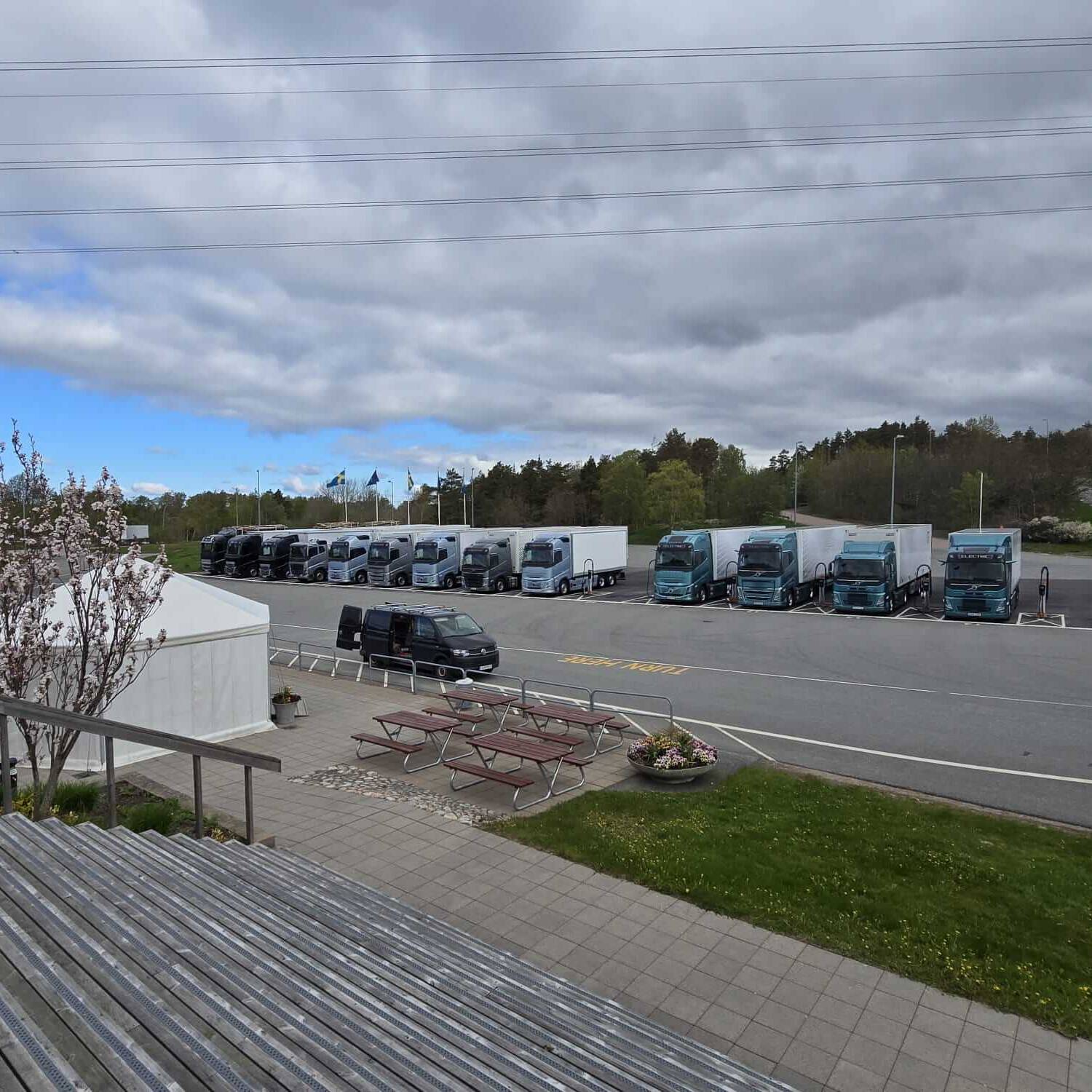
Welcome to the European Freight Leaders’ meeting at Volvo Trucks Experience Center in Gothenburg
By Roger Alm & Marie Carlsson

Why tracking decarbonisation in logistics over a decade matters
By the Kuehne Climate Center (KCC) & Kühne Logistics University (KLU)